
The Persistent Problem of Orbital Debris
Both accidents and intentional destructive events can produce large quantities of orbital debris that remain as threats for years or centuries. Orbital debris is a global problem and shows the need to work together to ensure space sustainability. Two recent events highlight this problem:
2007 Chinese ASAT Test - January 11, 2007
- On January 11, 2007, China used a modified ballistic missile with an interceptor onboard to destroy its own inoperable Fengyun-1C weather satellite
- The destruction created more than 3,000 pieces of trackable space debris which quickly spread out across a large region of Earth orbit, covering between 300 and 2,000 km in altitude
- Many of these pieces remain in the original polar orbit, the prime location for most Earth observation satellites, including weather and climate satellites operated by the world's space agencies
- NASA's debris experts estimate that the test created perhaps as much as 150,000 pieces of debris too small to track. Most of these will remain in orbit, posing a serious threat to working satellites in low Earth orbit (LEO) for decades
Iridium-Cosmos Collision - February 10, 2009
- On February 10, 2009, an active American Iridium commercial communications satellite and an inactive Russian military communications satellite collided accidentally at an altitude of 800 kilometers
- The collision created more than 2,000 pieces of trackable debris that spread along and around the former satellites' orbits and now threaten other satellites in the LEO region
- While there was data beforehand showing that this collision was likely, neither the United States nor Russia was actively checking these particular satellites for possible collisions at the time
Active Satellites and Debris in Orbit
The U.S. military maintains the world's most extensive orbital tracking network, recording (in 2014) some 23,000 objects in space measuring 10 cm in diameter or larger. What cannot be reliably tracked yet are the objects smaller than 10 cm because these are too small to follow consistently. Scientists estimate that about 500,000 bits of junk measuring 1 to 10 cm orbit Earth and believe that many millions smaller than 1 cm exist. All objects in Earth orbit travel at extremely high speed. The average velocity of both satellites and debris in LEO is 7 kilometers per second (15,600 miles per hour) and 3.1 kilometers per second (7,000 miles per hour) in GEO. Therefore, even very small ones can cripple or destroy working spacecraft or endanger astronauts.
As of August, 2014, there are an estimated 1,235 active (functional) satellites in Earht orbit. The vast majority of these satellites are in Low Earth Orbit (LEO below 2,000 km altitude, or in geostationary earth orbit (GEO) at 36,000 kilometers altitude.
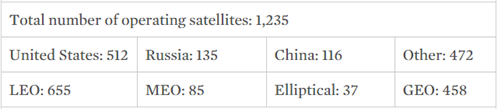
Total number of active satellites in orbit as of August, 2014. Source: Union of Concerned Scientists.
Knowing more about the nature of the problem is critical to space sustainability. Sharing information about orbital debris, mitigating its production and even developing capabilities to remove existing debris represent key objectives toward ensuring that conditions in outer space are favorable to continued use.
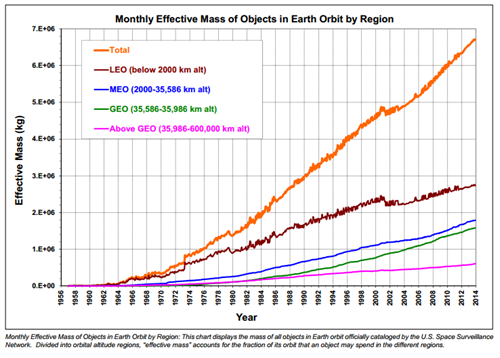
Total effective mass of space objects in orbit as of January 2015. Source: NASA Orbital Debris Quarterly
This chart displays a summary of the effective mass of space objects in Earth orbit officially catalogued by the U.S. Space Surveillance Network. The SSN typically only tracks objects larger than 10 cm in size, and can only catalog objects that are associated with a known space launch. Most of the orbital space debris ans mass can be found in the LEO region.
 Share
Share